Teen Patti sequence list, from trail to high card
“Sequence list” is often used for the whole ranking. Within that list, a sequence has the narrower meaning of three consecutive ranks. This chart uses classic rules with no wild cards.
The six categories
| Category | Example | How to recognise it |
|---|---|---|
| Trail / trio | 8♠ 8♥ 8♦ | Three of one rank. |
| Pure sequence | 6♣ 7♣ 8♣ | Three consecutive ranks in one suit. |
| Sequence / run | 6♣ 7♥ 8♦ | Three consecutive ranks in mixed suits. |
| Colour / flush | 2♣ 8♣ Q♣ | One suit, without a run. |
| Pair | 9♥ 9♣ 3♦ | Two of one rank and a different third card. |
| High card | 2♠ 8♥ Q♦ | No pair, run or colour. Read from the highest card down. |
Visual ranking chart
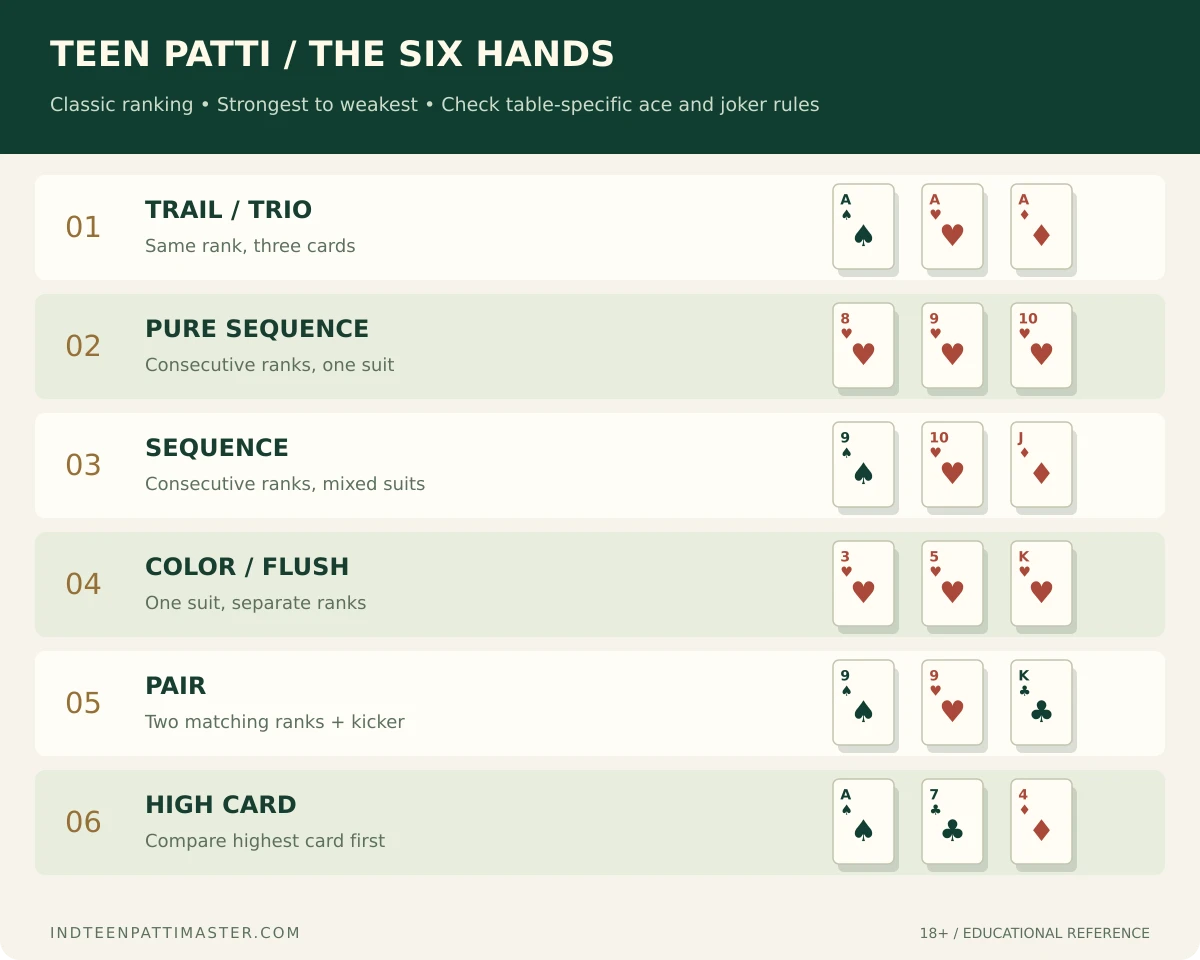
Classify all three cards
Look for three equal ranks first. Next check whether the ranks run together, then whether the suits match. Only after ruling those out should you look for a pair or compare high cards.
Pure sequence
3♦ 4♦ 5♦ is pure. Changing 4♦ to 4♣ leaves the ranks in order but turns the hand into an ordinary sequence.
Ace at either end
A-K-Q and A-2-3 can both be runs. Tables differ on their relative position. K-A-2 does not wrap around in the classic game.
Trail against a run
2♥ 2♣ 2♦ outranks even a pure sequence under classic rules. Check the category before the face value.
Two sequences
For ordinary runs with no aces, 7-8-9 ranks above 6-7-8. Within one category compare ranks, without giving a suit an extra value.
When ranks match
Two matching pairs are compared on their third cards. If every comparison is equal, apply the table’s procedure for the type of show.
Teen Patti and 3 Patti
Both names refer to three cards. A spelling change does not specify an ace convention or a wild card.
Quick check
Is a flush stronger than a mixed-suit run?
In classic Teen Patti the run comes first. In the example chart, sequence is third and colour fourth.